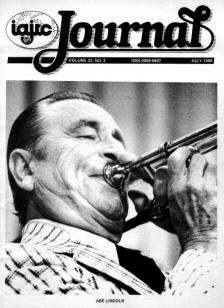
Abe Lincoln
by Floyd Levin
This article appeared in the November 1999 issue of Jazz Journal International and is reproduced here with the author's permission.
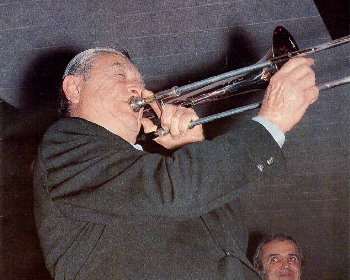
Trombonist Abe Lincoln, at 92, is among the few living jazz greats whose extended careers thrived during the Jazz Age, the Swing Era, the Dixieland Revival, and continued almost to the present. Lincoln is also a member of a select group of influential artists who are highly admired by fellow musicians but have eluded the attention of the average jazz fan. His name appears only briefly in most source material usually in reference to his activities as a sideman with noted leaders. Few publications have printed major articles depicting his elaborate career.
This profile is intended to rectify that unfortunate oversight. I clearly recall the first time I heard him. It was October 15, 1955 on the huge stage of Los Angeles' Shrine Auditorium during Frank Bull and Gene Norman's Eighth Annual Dixieland Jubilee. Cornetist Bobby Hackett, making a rare West Coast appearance, fronted an all-star band. I marveled at the robust sounds created by the tall handsome trombonist. A glance at the program identified him as Abe Lincoln. The band also included: Matty Matlock, clarinet; Nappy Lamare, guitar; Don Owens, piano; Phil Stephens, bass; and Nick Fatool, drums.
Reviews following the event praised Hackett's combo and especially lauded the tall handsome trombonist. The Dixieland Jubilee concert was a “warm-up” for the Hackett group's memorable record date that followed. A few days later, the same band, with Jack Teagarden added, recorded ten tunes for Capitol Records. Hackett's lovely tone was then enhancing several Jackie Gleason albums of mood music, but he had retained his hot jazz skills. When released, the album, Coast Concert, presented an informal Dixieland sound reflecting the happy rapport among the players and showcasing the pair of world class jazz trombonists sharing the solos. It is still considered one of his best sessions of the decade.
“Teagarden and I were havin' a ball working together,” Abe told Bill Spilka in a 1978 interview. “During the recording date, there was never a feeling of competition. I realize that nobody can play like Jack - but I always had a flashy spirited style of my own! So we got along just great!” When asked how it was to record with Abe Lincoln, Teagarden replied, “Fine! I just got out of the way when it was Abe's turn!”
Abram (Abe) Lincoln was born in Lancaster, Pennsylvania on March 29, 1907. “A lot of good musicians came from that coal mine area,” he said during Spilka's interview. “The Dorsey Brothers, Fuzzy Farrar, Russ Morgan, the Waring Brothers, etc. There was a good little college group called the Maple Leaf Orchestra. “My Dad, John Lincoln, played cornet in the Lancaster City Band and the Iroquois Band. He would take me with him when I was a youngster and sat me behind the trombone players so I could follow the music over their shoulders.”
Abe always spoke reverently about his father, although he was a strict taskmaster. “He taught my brothers and me how to play our instruments. He was proud of us, I'm sure, but he never gave us credit. No matter how well we played, he'd say, 'You could have played it better!' He was right. That made us pay attention to what we were doing. Any smart teacher will do this. Music is one study that never ends—so you can't get too good! Just play. Let the audience decide how good you are. That was my Dad's philosophy—and it worked! “I only had a grade school education—I was more interested in playing the horn than going to school. I spent my whole life playing. I started to make money on the horn when I was six or seven years old. I played a solo on the peck horn in my hometown on New Years day. I got five dollars for first prize.
“I had five brothers—three were musicians. Bud and Roy played trumpet, and Chet played trombone. My brother Bud would have been right up at the top of the trumpeter's [list] if he hadn't had a fatal accident. He was on a par with Phil Napoleon, leader of the Original Memphis Five, then the leading white jazz group in the country.” Bud Lincoln formed a six piece band in 1921. He played trumpet and Abe was the fourteen year old trombonist. They took almost any job offered to them—strawberry festivals, dances, parties, picnics, college proms, etc.
“Bud was six years older than me. He went to the dances, heard all the bands and brought the tunes home for me to learn. After we learned a lot of songs, I began improvising. You know, I could take a tune and 'noodle' around with it without the music—spontaneously. I'm not bragging, but it did come naturally. Bud Lincoln and his Jazz Band broke attendance records at the local Bach Dance Auditorium and also played a summertime engagement at the Rocky Glen Park in Scranton, Pennsylvania.
Abe remembers two recording dates with his brother's band for the Edison and Victor labels. The Edison records were rejected, and Victor decided not to release the Lincoln records because the company had a contract with the Original Memphis Five and “did not have room for another jazz band.” (Miff Mole, the OM5's esteemed trombonist was one of Abe's earliest influences.) Abe's first issued recordings were with Ace Brigode and his Fourteen Virginians on the Okeh label in 1924. “Ace approached my father to let me go to New York with his band when I was about 16 years old. He had a hotel band—a good band to dance to. It was a corny band, but I didn't care, I was getting paid!”
Recalling one of the first Brigode record sessions in New York City on October 13, 1924, he said, “It was Alabamy Bound. I think I played a sixteen bar solo or a chorus. At that time, we had no microphones—we blew into those large conical horns. It was a 78 RPM Columbia, but I never heard the record.”
“I made a study of 'false positions.' People say, 'You don't move the slide very much.' I tell them, 'You don't have to move it very much—the notes are in there if you know where they are!' I used to play a jazz chorus with a piece of hotel stationary over the bell—the thin paper vibrated and sounded like a kazoo.”
A discographical exploration of Abe Lincoln's recording activities underscores the importance of his role in the jazz scene. Since those early sessions with Ace Brigode in 1924–25, his shellac and vinyl trail covers a broad spectrum of the music. When Abe left Brigode in February 1925, he joined James B. Dimick's Million Dollar Sunny Brook Orchestra and went to Detroit to play at the Arcadia Dance Hall and the Hollywood Theater. After the dates with Dimick's Orchestra, Abe returned to New York. When he joined the popular California Ramblers in New York 1926, the adolescent recording industry was paralleling the public's increasing interest in a new exciting music and the Ramblers provided many recording opportunities for Abe. His powerfully humorous touches on their recordings influenced several generations of jazz trombonists; that influence continues to this day.
“We were under contract to Columbia Records,” he told me when we chatted during his 90th birthday party at his home in Van Nuys, California. “That didn't prevent us from recording for other labels using different names. For Pathé Actuelle, we were the 'Palace Garden Orchestra.' On Perfect, we were billed as 'Meyer's Dance Band.' Grafton Records called us the 'Windsor Orchestra'.” Abe said that the Ramblers' various groups made more records than any band in New York. During the month of April 1926, they recorded over a dozen tunes using several pseudonyms on ten different labels.
The California Ramblers were in a recording studio almost weekly. Using numerous band names, their records appeared on most of the independent labels active in the mid-'20s including: Edison, Harmony, Silvertone, Pennington, and Broadway. “I made quite a few records with the California Ramblers—I never heard them afterwards. We were one of the first bands to record with a microphone. I think it was I'd Climb the Highest Mountain for Columbia Records at a Columbus Circle studio in Manhattan. After listening to a playback, we all said, 'What a difference!' It was much easier on the guys making the records. It meant more relaxation, less nervousness, etc.
Despite their name, the California Ramblers were not from the West Coast and never played there. The Ohio group was formed by banjoist Ray Kitchenman in 1921, and named after their early venue, the Ramblers Inn on Pelham Parkway, Bronx, New York. Violinist Arthur Hand was the leader. Ed Kirkeby, the group's manager/agent had extraordinary marketing skills and soon secured bookings for them in prestigious venues. A decade later he masterminded Fats Waller's career.
The importance of the California Ramblers in jazz's history has been overshadowed by their reputation as a dance band. They were far ahead of contemporaries who retained a tense rhythmic and melodic rigidity. Unlike the other leading dance bands of the '20s, led by Roger Wolfe Kahn, Ray Miller, Isham Jones, and Paul Whiteman, the Ramblers featured a buoyant rhythm section sparked by drummer Stan King. Their exuberant music anticipated the oncoming Swing Era, and was often based on stock arrangements cleverly modified to feature hot solos by the best jazz men in New York.
An integration milestone occurred when cornetist Bill Moore joined the band; he became the first regular black member of a white orchestra. Over the years, the California Ramblers' personnel included, at various times, the top rated instrumentalists of the day, including: Spiegle Willcox, Chelsea Qualey, the Dorsey Brothers, Fud Livingston, Red Nichols, Phil Napoleon, Miff Mole, and Adrian Rollini.
“This was about the time I met Tommy Dorsey,” Abe told Bill Spilka during an interview in 1978. “He used to ask me how I'd do things—how I played things [on the horn]. He'd say, 'How do you do this?' I'm talking about Tommy Dorsey! I said cheeze! I think he was the finest trombonist that ever lived. The way he handled his breathing, and everything he did. Tommy was a perfectionist—and he's asking me these questions! I said, 'I don't know how to tell you, Tom. You'll get that feeling—and that's it!' That's all I could tell him!”
After the Detroit jobs, Abe organized his own orchestra, which included his three brothers in the brass section. In the '30s, Abe worked with bands led by Roger Wolfe Kahn, Leo Reisman, Paul Whiteman, and Ozzie Nelson. He left New York with Nelson's orchestra when they came to California to appear on the Joe Penner radio program. When Nelson returned to the East in 1936, Abe remained in Los Angeles and soon joined the ranks of the busy radio studio musicians. “In those days, the studio orchestras were signed up for 26 weeks. I paid no attention to who the star was. I just played the music. It's a business—a livelihood. I played first chair trombone in radio studios for 25 years.”
His trombone is heard on recordings with Bing Crosby (1937, 1941), Hoagy Carmichael and Pinky Tomlin (1938), and Judy Garland (1939). Lincoln's horn was also an important voice in several Walter Lantz Woody Woodpecker cartoons and Buster Keaton comedies. He could bray like an elephant and create humorous animal sounds to merge with the action on the screen.
When Dixieland music was resurrected during the '40s, Abe returned to jazz and recorded with Wingy Manone, “Wild Bill” Davison, Pete Fountain, Bob Scobey, Matty Matlock, and Red Nichols.
From 1953–60, Matty Matlock's Paducah Patrol and his Rampart Street Paraders recorded scores of tunes for Warner Brothers and Columbia Records using the finest Dixieland players including Abe Lincoln, Clyde Hurley, John Best, Eddie Miller, George Van Eps, Stan Wrightsman, Morty Corb, and Nick Fatool.
After a hiatus of several years, he surfaced with “Wild Bill” Davison's band at the “Championship of Jazz” that began August 1, 1975 in Indianapolis, Indiana. During one set, while the band was playing All of Me, Davison, who considered Abe one of his favorite trombonists, without warning, pointed to him to sing the chorus. Slightly flustered, Abe forgot some of the lyrics and finished the chorus on his trombone. Davison, looking up to the balcony, told the audience, “Abe was a little unsettled on that tune. He thought he saw John Wilkes Booth up there!”
In 1976, Abe was a featured artist at the Sacramento Dixieland Jubilee. “They asked me to lead a sixteen-piece trombone choir—I guess with every trombonist at the festival. I made the arrangements on the spot—I told them, 'I'll take the intro and play the first chorus—then each of you play a 32 bar solo—we'll harmonize behind you. Then I'll do a few choruses and we'll end with a big chord.' The fans in Sacramento loved it!”
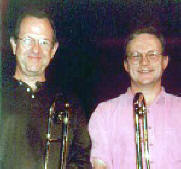
Twenty three years later, the 1999 Sacramento festival was the scene of a special Abe Lincoln tribute by trombonists Bill Allred and Mike Pittsley. Lincoln's two ardent admirers played Ida, Sweet As Apple Cider based on his classic recording with Matty Matlock four decades before. Their high octane duet shook the venerable Crest Theater with an effervescent swing.
Allred, a disciple of Abe's, leads his Classic Jazz Band from Orlando, Florida playing the same Matty Matlock Paducah Patrol arrangements that established his mentor as a front runner during the revival era. Pittsley, a member of the Jim Cullum Jazz Band, is also greatly influenced by Abe Lincoln. When I asked him to define the Lincoln style, he said, “He is very extroverted—always front and center. He has an immediately identifiable sound. When I play a hot solo, Abe is always in my mind's ear!”
Abe gracefully side-steps questions regarding his unique name and an apocryphal tale that has been told and re-told by musicians and fans over the years. The story, apparently only partially based on a factual incident, is so appropriate, it should be included here. This is one of the many versions: It seems that Abe and another noted trombonist were stopped for a traffic violation while driving home together after a job. The police officer grimly asked Abe, the driver, “What's your name?” He replied, “I'm Abe Lincoln.” The officer, obviously annoyed, said, “O.K. Wise guy! I guess your buddy there is George Washington!” Abe answered, “As a matter of fact, he is—this is George Washington!” His companion was George Washington, a highly respected former member of orchestras led by Don Redman, Benny Carter, Fletcher Henderson, and Louis Armstrong.
He also reluctantly admitted wearing a stove pipe hat and a black morning coat during a recording session with Paul Weston. “The hat didn't fit me,” he added, “but Paul wanted a photo for the album cover, so what the hell, I did it!”
A very memorable event occurred on August 2, 1999. A select group of Abe's family and friends gathered in his home to witness an intimate concert/love-in by the Jim Cullum Jazz Band. The famed group, on a three-week West Coast tour, flew from Northern California to pay a special tribute to their ailing inspirational champion. They played for our small gathering with the same verve they would project for a major concert crowd. Abe, seated next to his colleague, drummer Nick Fatool, beamed broadly and enjoyed the sincere tribute.
This long overdue profile of Abe Lincoln is far from complete. There are many facets of his lengthy career that still require exploration. Hopefully, one day, jazz scholars will uncover those additional facts. Until then, this piece will partially illuminate the significant role he played in the ongoing classic jazz experience.
The above information was assembled from material in this writer's files and conversations with Abe Lincoln. I am also indebted to British trombonist-bandleader Tony Bracegirdle for encouraging this project and to Bill Spilka and Mike Pittsley for generously sharing their unpublished interviews conducted with the trombonist in 1978 and 1995. Shirley Klett's excellent article, “The Name Is Abram,” in the Journal of the International Association of Jazz Record Collectors, July 1989, was very helpful. Additional assistance was provided by jazz research specialist Eugene E. Grissom, jazz film archivist Mark Cantor, and Abe Lincoln, Jr.